
The Market Just Did Something That Makes No Sense
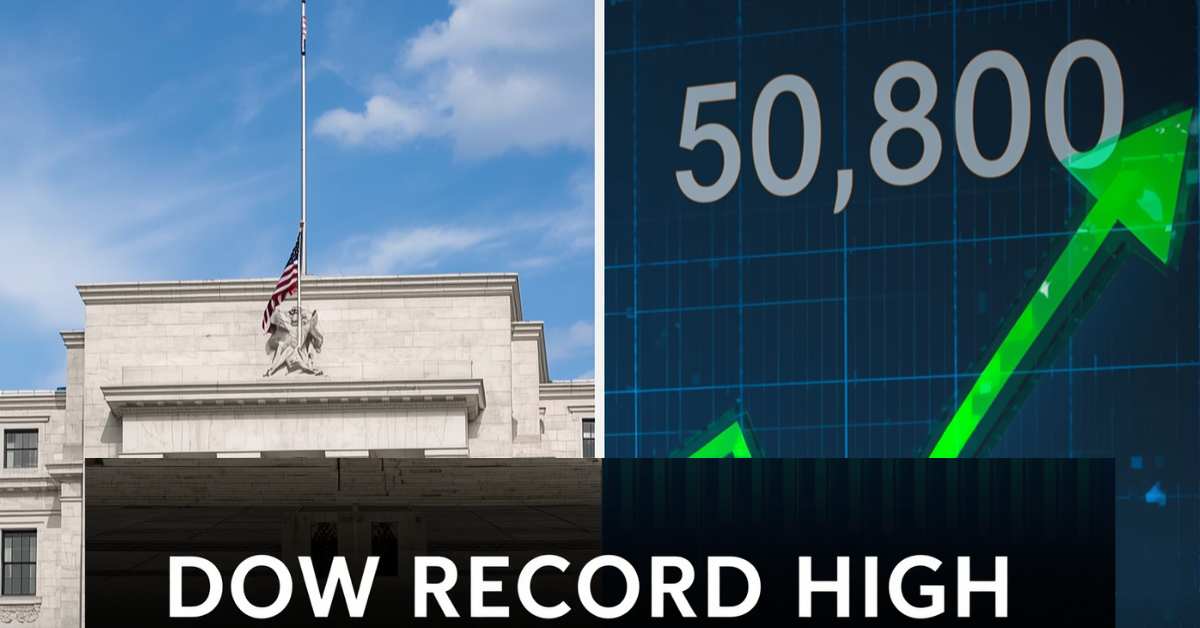
On a day when everything seemed designed to push stocks down, the Dow Jones Industrial Average did the opposite — grinding out a fresh all-time high above 50,800 .
Here is what happened on Friday, May 22:
| Event | Expected Market Reaction | Actual Reaction |
|---|---|---|
| Kevin Warsh sworn in as Fed Chair (known hawk) | Stocks sell off | Stocks rallied to record |
| Consumer sentiment crashes | Stocks sell off | Stocks ignored it |
| Inflation expectations surge | Stocks sell off | Stocks ignored it |
| Fed’s Waller says “Crazy” to discuss rate cuts | Stocks sell off | Stocks ignored it |
| Iran peace deal remains elusive | Stocks sell off | Stocks priced in hope anyway |
The tape wanted a record and took one .
But here is the problem: The bond market and the stock market are living in two completely different realities. And one of them is about to be proven very wrong .
The Numbers That Should Have Mattered (But Didn’t)
1. Kevin Warsh Takes Over — A Hawk Takes the Gavel
Kevin Warsh was sworn in as the new Federal Reserve Chair on Friday. His track record is unambiguously hawkish: He wants to shrink the Fed’s balance sheet, reform how the Fed guides markets, and has been critical of easy-money policies .
What this means: A structural headwind for risk assets. This is not the easy-money backdrop stocks have enjoyed for years .
President Trump — who spent two years demanding rate cuts — has softened, conceding he will let his new chair do as he sees fit. That reads like a quiet admission that rate cuts are not coming .
2. Consumer Sentiment Crashed — Inflation Fears Surged
Friday’s University of Michigan survey was ugly:
| Metric | May 2026 Reading | Forecast | Direction |
|---|---|---|---|
| Consumer sentiment | Dropped sharply | Below consensus | 🔴 Worse |
| Expectations | Dropped sharply | Below consensus | 🔴 Worse |
| 1-year inflation expectations | Rose | Above forecast | 🔴 Worse |
| 5-year inflation expectations | Rose to 3.9% | Above forecast | 🔴 Worse |
Source: University of Michigan Survey
This is the stagflation-lite cocktail in miniature: softer confidence and stickier prices together .
3. Fed’s Waller: Discussing Rate Cuts Is “Crazy”
Fed Governor Christopher Waller struck a pointedly hawkish tone on Friday, speaking at an economic forum in Frankfurt, Germany .
His key quotes:
“Inflation is not moving in the right direction. In the current situation, talking about a rate cut in the near term is a bit crazy. You can’t look at this data and seriously say the Fed might cut rates in September.”
“The recent data on inflation and employment have changed my stance, which was previously leaning toward rate cuts.”
Source: Fed Governor Christopher Waller speech, May 22, 2026
Waller stopped short of calling for an immediate rate hike but made clear: If inflation doesn’t cool quickly, he will support raising rates. He specifically warned that if market inflation expectations start to become unanchored, he would not hesitate to support raising the federal funds rate target range .
4. Iran Peace Deal: Hope Without Evidence
The story driving some of the stock market optimism is that a US-Iran peace deal is close — perhaps imminent .
The trouble: The same story has been “close” for weeks. The early-April ceasefire has been called “barely alive” by the US president himself. Tehran’s latest proposal was waved off. Fire is still being traded near the Strait of Hormuz with oil holding above $100 per barrel .
Talk of a breakthrough keeps surfacing from unnamed sources, but no document has been produced. Some doubt a draft exists at all .
Leaning on a peace dividend that may never arrive is leaning on hope.
The Bond Market Tells a Different Story
Here is where the stock market and the rate market part company completely .
| Timeframe | Rate Market Pricing |
|---|---|
| June Fed meeting | Effectively no chance of a move (near-certain hold) |
| By October | A hike is priced as more likely than a hold |
| By December | >70% odds rates will be higher than today |
| Probability of a 2026 rate cut | Zero |
Source: Rate futures markets, CME FedWatch Tool
The Fed has held its benchmark at 3.50% to 3.75% through its last two meetings. The April CPI ran hot near 4% year-over-year. And the bond market has quietly decided: The next move, if there is one, is up.
After Waller’s comments, interest rate swap markets fully priced in a 25 basis point rate hike by December for the first time. Markets even began pricing in a chance of a September or October rate hike .
The Earnings Season Buffer Is Gone
For the past several weeks, the stock market has been able to ignore bad macro news because corporate earnings were spectacular.
That buffer is now gone.
According to LSEG IBES data, over 90% of S&P 500 companies have reported results, with Q1 earnings expected to grow more than 28% year-over-year . This allowed the market to digest higher yields and higher energy prices.
But: The earnings season is now effectively over. Investors are shifting focus from earnings to the macro environment — inflation, oil prices, bond yields, and the Fed .
Ameriprise Chief Market Strategist Anthony Saglimbene put it directly: “Corporate earnings reporting season is basically over.”
What’s Next: The Three Big Tests Next Week
US markets are closed Monday for Memorial Day. Thin liquidity into the long weekend makes a low-volume melt-up easy to manufacture — and hard to trust .
Thursday brings the April Personal Consumption Expenditures Price Index (PCE) — the Fed’s preferred inflation gauge and a top-tier release .
| Event | Date | Why It Matters |
|---|---|---|
| April PCE (Core) | Thursday, May 28 | Fed’s preferred inflation gauge |
| Q1 GDP (2nd estimate) | Thursday, May 28 | Economic growth health check |
| Consumer Confidence | Thursday, May 28 | Spending power indicator |
With long-term yields already at multi-year highs (30-year Treasury at 5.19%, highest since 2007), any hot PCE print would only reinforce the hawkish path the rate market is already pricing .
A soft print buys the bulls another week of denial .
What This Means for Your Wallet
Your Mortgage and Home Equity
The 30-year fixed mortgage rate is already near 7.2%. With the bond market pricing in a 70%+ chance of a Fed rate hike by December, mortgage rates could climb toward 8% in 2026 .
Action step: If you are buying a home, do not wait for lower rates — they are not coming. If you have an adjustable-rate mortgage (ARM), consider refinancing to a fixed rate now before rates rise further.
Your Credit Cards and Loans
The 2-year Treasury yield — which directly influences credit card and auto loan rates — has surged to a 15-month high above 4.10% since the Iran war began .
Action step: Pay down variable-rate debt aggressively. A balance transfer to a 0% APR card can save you thousands in interest before rates rise further.
Your Savings Account (The Bright Spot)
Higher rates mean better returns for savers. High-yield savings accounts are still offering 3.5% to 3.7% APY. If the Fed actually hikes rates, these could climb toward 4.5%.
Action step: Lock in a 12-24 month CD at 4.0% to 4.5% now. Consider a CD ladder to balance locking in rates with maintaining liquidity.
Your 401(k) and Investments
The record high feels good — but the foundation is shaky .
| Sector | Outlook | Why |
|---|---|---|
| Technology | Vulnerable | Rate hikes hurt growth stocks |
| Energy | Positive | Oil >$100 + institutional rotation |
| Financials | Positive | Banks earn more with higher rates |
| Consumer discretionary | Negative | Tapped-out consumers can’t spend |
Plante Moran Financial Advisors Chief Investment Officer Jim Baird warned that long-term Treasury yields are challenging the bond market — and if this persists, it could set a “practical ceiling” for the entire stock market .
Action step: Take profits in overvalued tech names. Add exposure to energy and financials. Keep dry powder — the unwind from a record tends to move far faster than the grind that produced it
The Bottom Line
The Dow hit a record high on Friday. Kevin Warsh took over as Fed Chair. Consumer sentiment cratered. Inflation expectations surged. A Fed governor said discussing rate cuts is “crazy.” And none of it mattered to the stock market — at least not on Friday .
But the bond market is sending a very different signal: 70%+ odds of a rate hike by December. Zero chance of a cut in 2026. Long-term yields at 2007 highs. And the earnings season buffer is now gone .
For American households, this means:
- The stock market rally is running on thin conviction — and thinner holiday liquidity
- Rate cuts are officially dead for 2026 — and hikes are now the base case for late 2026
- Thursday’s PCE report is the next major test — a hot print could trigger a sharp market repricing
- Mortgage rates could climb toward 8% — buy now or risk being priced out
- Your savings account is the one winner — lock in CD rates before any potential Fed hikes
The honest read is a momentum tape running on thin conviction. Long into strength is fine while the Dow holds above 50,000, but this is not a level to marry. If Thursday’s inflation print runs hot or the Iran talks fall apart, the unwind from a record tends to move far faster than the grind that produced it .
Check back Thursday for our full coverage of the April PCE report — the single most important inflation data point for the Fed’s next decision.
Disclaimer: This article is for informational purposes only and does not constitute financial advice, investment advice, or tax advice. You should consult with a qualified U.S. financial advisor or tax professional before making any financial decisions. Past performance does not guarantee future results.