
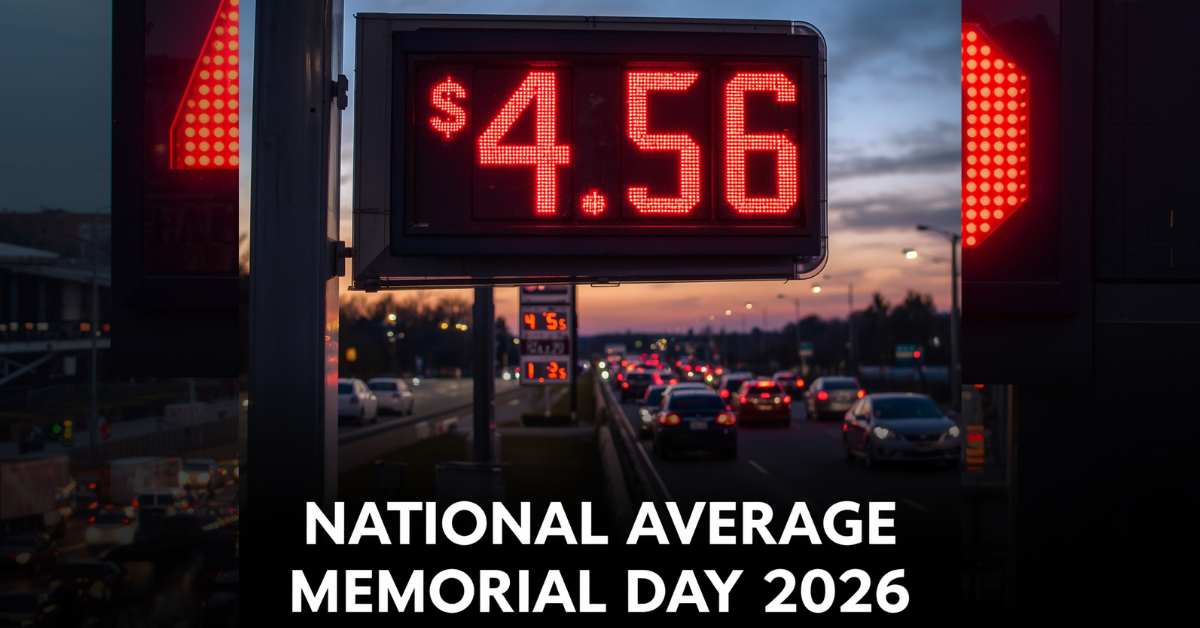
Record 45 Million Americans Are Traveling This Weekend — Despite $4.56 Gas
Memorial Day weekend 2026 is officially underway, and Americans are proving that high gas prices will not keep them home.
AAA projects a record 45 million people will travel at least 50 miles from home this holiday weekend — the highest Memorial Day travel volume on record . That is up from 44.8 million in 2025 and 42.8 million in pre-pandemic 2019 .
Of those, 39.1 million are traveling by car — the vast majority of holiday travelers . Another 3.66 million are flying, with the remainder traveling by bus, train, or cruise ship .
The travel boom comes despite the highest Memorial Day gas prices in four years. The national average for a gallon of regular gasoline stands at **4.56∗∗—up4.56∗∗—up1.38 from the same period last year and the highest holiday average since 2022 .
For American households, this weekend is a stress test of both the consumer’s willingness to spend and the real-world impact of the Iran war on everyday budgets .
The Numbers: Gas Prices by State
Gas prices vary dramatically depending on where you live — or where you are driving through.
| State/Region | Average Gas Price | Rank |
|---|---|---|
| California | $6.14/gallon | Highest in nation |
| Washington | $5.78/gallon | 2nd highest |
| Hawaii | $5.64/gallon | 3rd highest |
| Massachusetts | $4.61/gallon | Above national average |
| Mississippi | $4.01/gallon | Lowest in nation |
Source: AAA, May 2026
Key takeaway: Every state has crossed the 4pergallonthresholdforthefirsttimethisMemorialDayweekend.Sevenstatesarepostingaveragesabove4pergallonthresholdforthefirsttimethisMemorialDayweekend.Sevenstatesarepostingaveragesabove5 .
Why Gas Prices Are So High: The Iran War
The primary driver of this year’s gas price spike is the Iran war, now in its 12th week .
On February 28, 2026, the U.S. and Israel launched military strikes against Iran. The conflict has brought ship movement through the Strait of Hormuz — a narrow waterway that accounts for approximately one-fifth of the world’s oil supply — to a near standstill .
GasBuddy’s head of petroleum analysis Patrick De Haan attributes more than nine-tenths of the year-over-year increase at the pump directly to the conflict with Iran .
“These states are all paying quite a bit more compared to last year, and it’s very much because of what’s going on with the Strait of Hormuz,” De Haan told Axios. “That’s what happens when the world’s most vital waterway to the shipment of oil becomes a military target.”
The price outlook for the rest of the summer is not improving. GasBuddy’s modeling points to a nationwide per-gallon average of $4.80 for the full summer driving season .
Should the Hormuz closure drag on well into summer, analysts warn the record pump price of $5.02 per gallon — last touched in June 2022 — could return .
Seasonal Factors Are Making It Worse
Beyond the geopolitical shock, two recurring seasonal forces are also pushing prices higher :
| Factor | Added Cost |
|---|---|
| Reformulated summer-grade gasoline (federal environmental mandate) | +15 cents/gallon |
| Surge in summer road travel | +5 to 15 cents/gallon |
These seasonal factors layer on top of the Iran-driven spike, meaning drivers are paying a “war premium” plus the usual summer premium.
The Timing Problem: Many Travelers Booked Before the War
Here is a critical detail that explains why travel volumes are still high despite record prices: Many of these trips were booked before prices really skyrocketed .
AAA spokesperson Mark Schieldrop explained that a lot of travel is planned three to six months ahead of time — before the Iran war began on February 28 .
“Those travelers may not have felt the full impact of higher gas prices when they booked those trips. The price difference is especially great for air travelers who booked flights before the start of the war.”
Among road-trippers who booked hotels or accommodations before the price increases, the majority will still drive even though they were not expecting $4.50+ gallon gas when they booked .
The bottom line: The full impact of higher gas prices on travel behavior may not be visible until the July 4 holiday forecast .
Americans Are Prioritizing Travel — But Making Sacrifices Elsewhere
Despite the sticker shock at the pump, Americans remain determined to travel.
“It’s very clear that people are determined to travel no matter what,” Schieldrop said. “In the context of our forecast, traveling more than 50 miles from home is not that long of a journey and not every trip has to be a luxury experience. Consumers may be stretched, but they’re making sacrifices in other spending categories to make travel happen.”
This is consistent with what consumer debt data has been showing: Americans are still spending, but they are stretching — using credit cards and cutting back in other areas to afford the experiences they want.
Top destinations for Memorial Day 2026 include :
| Rank | Domestic Destination | International Destination |
|---|---|---|
| 1 | Orlando | Rome |
| 2 | Seattle | Vancouver |
| 3 | New York City | Paris |
| 4 | Las Vegas | London |
| 5 | Miami | Athens |
Boston ranks 10th among U.S. destinations this holiday weekend .
Best and Worst Times to Drive (If You’re Still on the Road)
If you are traveling this weekend — or heading home — AAA has released guidance on the best and worst times to hit the road .
| Day | Worst Times (Avoid) | Best Times |
|---|---|---|
| Friday | 11 AM – 8 PM | Before 11 AM or after 9 PM |
| Saturday | 12 PM – 5 PM | Before 11 AM |
| Sunday | Minimal traffic expected | All day |
| Monday | 12 PM – 5 PM | Before 10 AM |
Source: AAA
What This Means for Your Wallet
Your Summer Travel Budget
The bad news: Gas prices are not coming down anytime soon. If the Strait of Hormuz remains blocked, the national average could hit 4.80thissummer—andpossibly4.80thissummer—andpossibly5.02 if the conflict drags on .
Action step: If you are planning summer travel, budget for gas at 4.80to4.80to5.00 per gallon. If you can book trips that do not require long drives, consider trains or buses as alternatives.
Your Credit Card (If You’re Putting Travel on Plastic)
Many Americans are charging travel expenses on credit cards. With the Fed now openly discussing rate hikes and credit card delinquencies already at Great Financial Crisis levels, this is a risky strategy .
Action step: If you are carrying travel debt, pay it down aggressively. Do not assume rates will drop — they won’t.
Your Grocery Budget
Higher gas prices mean higher shipping costs for everything you buy at the grocery store. The April CPI already showed fruits and vegetables up 6.1% year-over-year . More increases are coming.
Action step: Factor higher grocery bills into your summer budget alongside gas prices.
Your HYSA (The Bright Spot)
High gas prices = persistent inflation = Fed keeps rates high = your savings account keeps earning 3.5% to 3.7% APY.
Action step: Continue to keep your emergency fund in a high-yield savings account. Consider a CD ladder to lock in current rates.
The July 4 Forecast: A Truer Test
AAA’s upcoming July 4 forecast will show a more complete picture of how high gas prices are affecting summer travel .
“It’s fair to say that we’d see more growth year over year if gas prices were lower,” Schieldrop said. “With prices about $1.50 a gallon higher than last year, there’s no question that travel plans for many Americans will be scaled back.”
The question for July 4 is whether the “determined to travel no matter what” attitude holds after Americans have already felt the pain of $4.56 gas on Memorial Day weekend.
The Bottom Line
This Memorial Day weekend is a snapshot of America in 2026: record travel demand colliding with the highest gas prices in four years, driven by a war halfway around the world that has blocked the world’s most important oil shipping channel.
For American households, the takeaway is clear:
- Gas prices are not coming down soon — budget for 4.80to4.80to5.00 per gallon this summer
- The Iran war is directly hitting your wallet — nine-tenths of the price increase is conflict-related
- Travel demand remains strong — but the full impact may not show until July 4
- Credit card debt for travel is dangerous — delinquencies are already at crisis levels
- Your savings account benefits — high inflation keeps Fed rates high
The stock market is closed Monday for Memorial Day, but the bond market and oil traders are watching the Strait of Hormuz . If the conflict escalates further, prepare for even higher prices at the pump.
Check back Thursday for our coverage of the April PCE report — the Fed’s preferred inflation gauge — and what it signals about summer rate policy.
Disclaimer: This article is for informational purposes only and does not constitute financial advice, investment advice, or tax advice. You should consult with a qualified U.S. financial advisor or tax professional before making any financial decisions. Past performance does not guarantee future results.