
Discover 7 crucial things to know before opening a Roth IRA in 2026. Learn about contribution limits, investment rules, tax benefits, and common mistakes to avoid for maximum retirement growth.
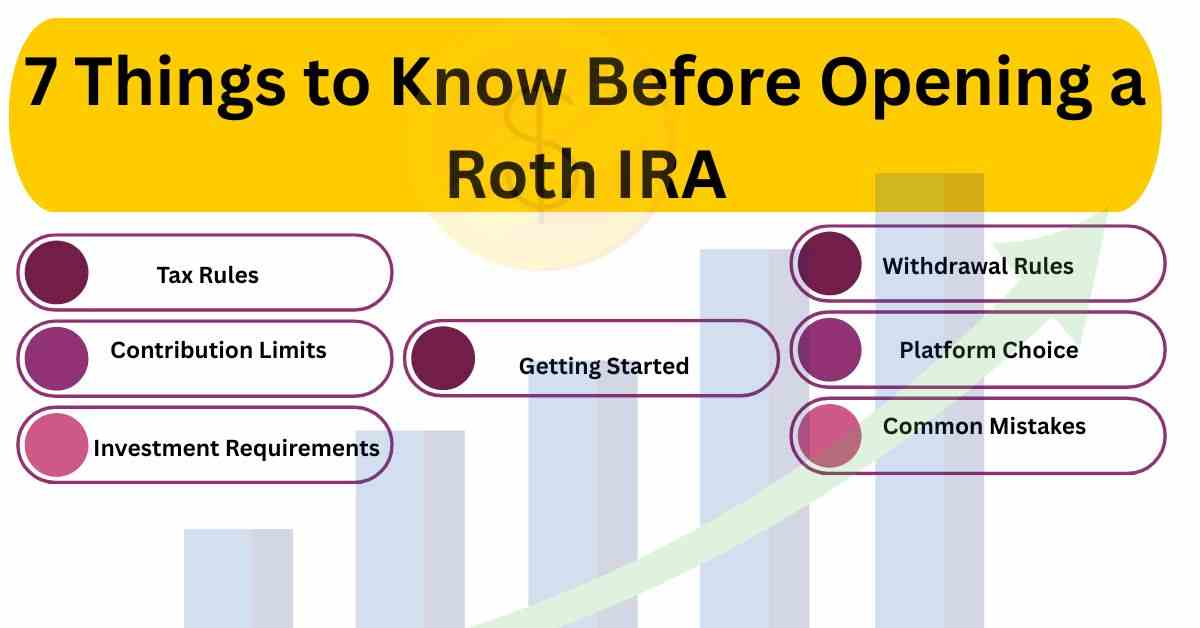
Things to Know Before Opening a Roth IRA
If you’re researching things to know before opening a Roth IRA, you’ve come to the right place. Many people jump into Roth IRA investing without understanding crucial rules that could cost them money in taxes, penalties, or missed growth opportunities. As someone who has successfully managed my Roth IRA for years, I’m sharing the essential things to know before opening a Roth IRA that most beginners wish they’d learned sooner.
Understanding these key things to know before opening a Roth IRA can mean the difference between building substantial tax-free wealth and making costly mistakes that undermine your retirement goals. This comprehensive guide covers the 7 most important things to know before opening a Roth IRA in 2026, ensuring you start your investment journey with confidence and clarity.
1. Understanding What a Roth IRA Really Is – Fundamental Things to Know Before Opening a Roth IRA
One of the most important things to know before opening a Roth IRA is understanding exactly what this account is and how it differs from other retirement options.
The Basics of Roth IRAs
A Roth IRA is an Individual Retirement Account that offers unique tax advantages:
- After-tax contributions: You contribute money you’ve already paid taxes on
- Tax-free growth: Your investments grow without annual tax on dividends or gains
- Tax-free withdrawals: Qualified distributions in retirement are completely tax-free
- Individual control: You manage the account separately from employer-sponsored plans
Common Misconceptions to Understand
- ❌ Myth: Roth IRAs reduce your current year tax bill
- ✅ Reality: You get tax benefits later, not now
- ❌ Myth: It’s a savings account with guaranteed returns
- ✅ Reality: It’s an investment account that requires active investing
Why this matters: Understanding these fundamental things to know before opening a Roth IRA helps you set realistic expectations and avoid disappointment about the immediate tax benefits.
2. Contribution Limits and Income Restrictions – Key Things to Know Before Opening a Roth IRA
Among the most crucial things to know before opening a Roth IRA are the contribution limits and income restrictions that could affect your eligibility.
2026 Contribution Limits
| Your Age | Maximum Annual Contribution |
|---|---|
| Under 50 | $7,000 |
| 50 or Older | $8,000 (includes $1,000 catch-up) |
2026 Income Limits for Full Contributions
| Filing Status | Full Contribution Allowed Up To | No Contributions Above |
|---|---|---|
| Single | $146,000 | $161,000 |
| Married Filing Jointly | $230,000 | $240,000 |
| Married Filing Separately | $0 | $10,000 |
Important Deadline Details
- Contribution period: January 1, 2026 – April 15, 2027
- Key insight: You have over 15 months to fund each year’s Roth IRA
- Pro tip: The extended deadline means you can make prior-year contributions while also funding the current year
Why this matters: These are essential things to know before opening a Roth IRA because exceeding limits can result in penalties, while understanding deadlines helps maximize your contribution opportunities.
3. Withdrawal Rules and Restrictions – Critical Things to Know Before Opening a Roth IRA
Understanding the withdrawal rules ranks among the most practical things to know before opening a Roth IRA, as these rules dictate when and how you can access your money.
Contribution Withdrawals (Your Most Flexible Money)
- Anytime access: Withdraw your original contributions tax-free and penalty-free
- No restrictions: No age requirements or waiting periods
- Example: If you’ve contributed $25,000 total, you can withdraw up to $25,000 anytime
- Important caveat: Withdrawing contributions undermines long-term growth
Earnings Withdrawals (Strictly Regulated)
- Age requirement: 59½ or older
- 5-year rule: Account must be open for 5+ tax years
- Qualified distributions: Must meet both age and time requirements
- Exceptions: First-time home purchase ($10,000 limit), education expenses, disability
Special Circumstances
- First-time home purchase: Up to $10,000 lifetime limit for qualified expenses
- Education expenses: Penalty-free (but not necessarily tax-free) for qualified costs
- Unemployment: Penalty-free for health insurance premiums
Why this matters: These withdrawal rules are vital things to know before opening a Roth IRA because they impact your financial flexibility and emergency planning.
4. Investment Requirements – Essential Things to Know Before Opening a Roth IRA
One of the most overlooked but critical things to know before opening a Roth IRA is that contributing money isn’t enough – you must actually invest it.
The Garden Bed Analogy
Think of your Roth IRA as an empty garden bed. Your contributions are the soil, but your investments are the plants that actually grow. Without investments, your money sits idle.
Common Investment Options for Beginners
| Investment Type | Examples | Best For |
|---|---|---|
| Total Market Funds | VTSAX, FSKAX | Maximum diversification |
| S&P 500 Index Funds | VFIAX, FXAIX | Large company focus |
| Target Date Funds | Vanguard Target Funds | Hands-off approach |
| ETFs | VTI, VOO | Low minimum investments |
The Cost of Not Investing
- Cash holdings: Typically earn minimal interest (0.01-0.05%)
- Inflation risk: Purchasing power decreases over time
- Opportunity cost: Missed market growth and compounding
Why this matters: This is one of the most important things to know before opening a Roth IRA because countless beginners make this mistake, leaving thousands in potential growth on the table.
5. Platform Selection – Practical Things to Know Before Opening a Roth IRA
Choosing where to open your account is among the most practical things to know before opening a Roth IRA, as different platforms offer varying benefits.
Top Roth IRA Platform Options
Vanguard:
- Industry pioneer in index investing
- Client-owned structure
- Excellent low-cost fund selection
- Strong long-term reputation
Fidelity:
- No account minimums or fees
- Zero-expense ratio fund options
- Excellent customer service
- Great for beginners
Charles Schwab:
- No account fees
- Excellent research tools
- Strong mobile platform
- Great customer support
Comparison Table: Key Platform Differences
| Feature | Vanguard | Fidelity | Charles Schwab |
|---|---|---|---|
| Account Minimum | $0 | $0 | $0 |
| Fund Minimums | Some $3,000+ | Mostly $0 | Mostly $0 |
| Expense Ratios | Very Low | Lowest | Very Low |
| Trading Commissions | $0 | $0 | $0 |
| Customer Service | 8/10 | 9/10 | 9/10 |
Why this matters: These platform considerations are crucial things to know before opening a Roth IRA because your choice affects costs, investment options, and overall experience.
6. Tax Implications and Benefits – Strategic Things to Know Before Opening a Roth IRA
Understanding the tax implications represents some of the most strategic things to know before opening a Roth IRA.
Tax Benefits Breakdown
- No required minimum distributions (RMDs): Unlike traditional IRAs, you’re not forced to withdraw at age 73
- Estate planning advantages: Tax-free inheritance for beneficiaries
- Tax diversification: Balances taxable and tax-deferred accounts
- No tax on investment changes: You can rebalance without tax consequences
When Roth IRA Makes Most Sense
- Current low tax bracket: Pay taxes now while rates are low
- Young investors: Decades of tax-free growth ahead
- Tax rate expectations: If you expect higher taxes in retirement
- Supplemental retirement savings: Beyond employer plans
Comparison: Roth vs Traditional IRA
| Aspect | Roth IRA | Traditional IRA |
|---|---|---|
| Tax Deduction | No | Yes (if eligible) |
| Tax-Free Growth | Yes | No |
| Tax-Free Withdrawals | Yes | No |
| RMDs | No | Yes |
| Early Withdrawal | Contributions anytime | Generally penalized |
Why this matters: These tax considerations are fundamental things to know before opening a Roth IRA because they determine whether this account type aligns with your financial situation.
7. Common Mistakes and How to Avoid Them – Protective Things to Know Before Opening a Roth IRA
Learning from others’ mistakes is among the most valuable things to know before opening a Roth IRA.
Most Common Roth IRA Mistakes
| Mistake | Consequence | Prevention |
|---|---|---|
| Not investing contributions | Zero growth | Invest immediately after contributing |
| Missing deadlines | Lost contribution space | Set calendar reminders |
| Exceeding income limits | 6% penalty annually | Monitor income and adjust |
| Early earnings withdrawals | Taxes + 10% penalty | Emergency fund separate |
| Wrong account type | Missed tax benefits | Compare Roth vs Traditional |
Proactive Protection Strategies
- Automate investments: Set up automatic contributions and investments
- Emergency fund: Maintain 3-6 months of expenses separately
- Income monitoring: Track earnings if near phase-out ranges
- Professional advice: Consult tax professional for complex situations
Why this matters: These protective things to know before opening a Roth IRA can save you from costly penalties and missed opportunities.
- Avoid common errors with help from the Consumer Financial Protection Bureau Retirement Planning“
- “Check financial advisor credentials at SEC Investment Adviser Public Disclosure
Bonus: Implementation Checklist – Actionable Things to Know Before Opening a Roth IRA
Pre-Opening Checklist
- Determine your eligibility based on income
- Calculate your affordable contribution amount
- Research and select your preferred platform
- Gather required documents (SSN, driver’s license, bank info)
- Decide on your initial investment strategy
Account Setup Steps
- Open account online (15-20 minute process)
- Link your bank account for funding
- Make your first contribution
- Set up your investments (don’t leave as cash)
- Designate your beneficiaries
- Consider automatic contribution setup
Ongoing Management
- Monitor your contribution limits annually
- Rebalance investments as needed
- Update beneficiaries after life changes
- Review performance quarterly
- Maximize contributions when possible
Frequently Asked Questions – Additional Things to Know Before Opening a Roth IRA
Can I have both a Roth IRA and employer retirement plan?
Yes, you can contribute to both a Roth IRA and a 401(k) simultaneously. The accounts have separate contribution limits and can complement each other in your retirement strategy.
What happens if I contribute too much?
Excess contributions face a 6% penalty each year until corrected. You’ll need to withdraw the excess amount and any earnings it generated.
Can I open a Roth IRA for my spouse?
Yes, spousal Roth IRAs allow contributions for non-working spouses as long as you file jointly and have sufficient household earned income.
How does a Roth IRA affect financial aid?
Roth IRA assets are typically not counted in federal financial aid calculations, making them advantageous for families with college-bound children.
When should I NOT open a Roth IRA?
You might reconsider if you need the money within 5 years, have high-interest debt, or lack an emergency fund. Also, if you expect to be in a much lower tax bracket in retirement, traditional IRA might be better.
Continue Your Financial Education
Now that you understand the essential things to know before opening a Roth IRA, you might want to explore these related topics:
- Fidelity vs Vanguard for Roth IRA: The Ultimate 2026 Comparison – Detailed platform analysis
- How to Open a Roth IRA at Fidelity – Step-by-step setup guide
- Index Funds vs Stocks vs Mutual Funds vs ETFs: The Ultimate 2026 Comparison – Investment education
You’re Ready to Begin Your Roth IRA Journey
Understanding these 7 essential things to know before opening a Roth IRA positions you for success in your retirement investing journey. You now have the knowledge to avoid common pitfalls, maximize tax advantages, and build substantial tax-free wealth over time.
Remember that the most important things to know before opening a Roth IRA is that starting early and contributing consistently matter more than perfection. Don’t let analysis paralysis prevent you from taking action. Open your Roth IRA today, start with whatever amount you can afford, and begin building your tax-free retirement future.
Your future self will thank you for taking this important step toward financial independence.