
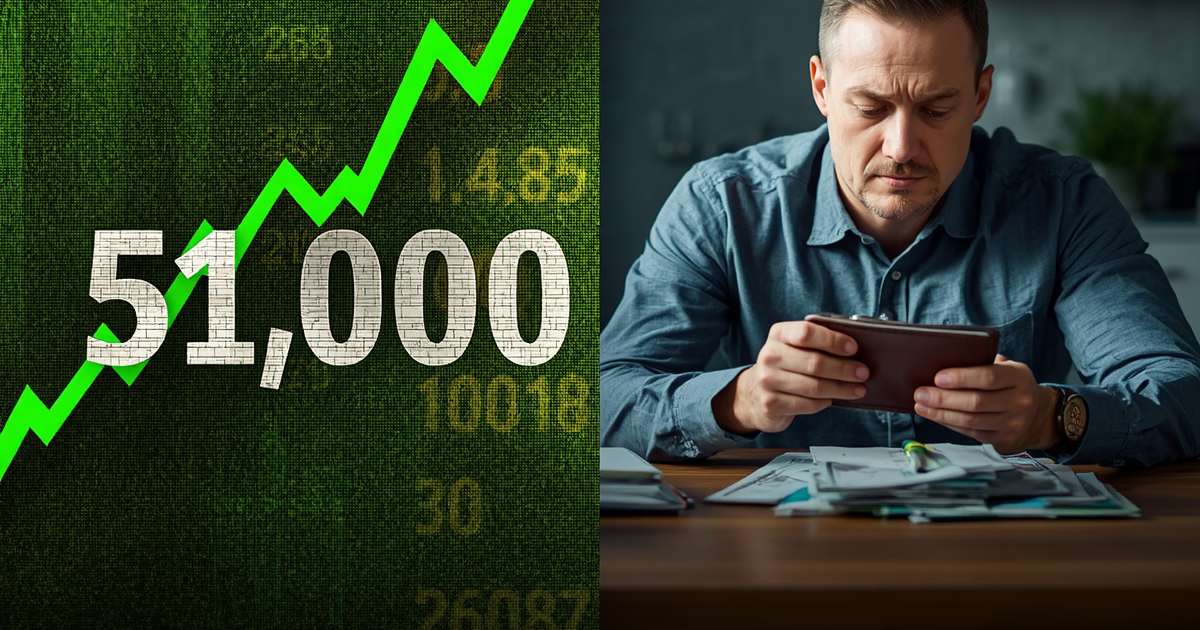
Consumer sentiment 2026 plunges to 44.8 — the lowest in 70 years — even as the Dow hits 51,000. What the great divergence between Wall Street and Main Street means for your money.
Consumer Sentiment 2026: The Lowest Reading in 70 Years
On Friday, the Dow Jones Industrial Average closed at 51,032 — yet another all-time high. The S&P 500 hit 7,580. The Nasdaq composite touched 26,972 .
On that same Friday, the University of Michigan released its final May reading of consumer sentiment 2026 : 44.8 .
That is the lowest consumer sentiment reading since this survey began in 1952 .
Let that sink in. For seventy years — through the 2008 financial crisis, through the COVID lockdowns of 2020, through the inflation crisis of 2022 — U.S. consumers have never felt this pessimistic.
Welcome to the two-speed American economy: Wall Street running on AI-fueled rocket fuel, while Main Street runs on fumes and credit cards.
This is your complete guide to consumer sentiment 2026 , what the 44.8 reading means for your wallet, and how to protect your finances in a divided economy.
Consumer Sentiment 2026: The Numbers That Tell the Real Story
Consumer Sentiment 2026: A Historic Collapse
| Metric | May 2026 Reading | Historical Context |
|---|---|---|
| Michigan Consumer Sentiment | 44.8 | Lowest since survey began in 1952 |
| Conference Board Confidence | 93.1 | Dragged down by energy inflation |
| Respondents citing “high prices eating savings” | 57% | More than half of all Americans |
Source: University of Michigan, Conference Board
To understand how dramatic this consumer sentiment 2026 collapse is, consider this: Americans are more pessimistic now than they were during the 2008 financial crisis. The collapse of Lehman Brothers. The Great Recession. Unemployment spiking to 10%. All of that felt better to consumers than today’s combination of high prices and geopolitical chaos.
The consumer sentiment 2026 reading of 44.8 is not just a number — it is a warning signal flashing red for the entire U.S. economy.
Consumer Confidence 2026: The Conference Board Confirms the Trend
The Conference Board’s consumer confidence 2026 index tells the same story. At 93.1 , confidence is being dragged down by persistent energy inflation. The Iran war has pushed gasoline above $4.50 per gallon nationally, and Americans are feeling the pain at every transaction.
Consumer confidence 2026 surveys show that 57% of respondents now say high prices are actively eating into their savings. More than half of all Americans are watching their emergency funds dwindle in real time.
Retail Sales: Not as Good as They Look
April retail sales appeared decent on the surface: up 0.5% month-over-month and 4.9% year-over-year .
But after you deduct 3.8% inflation? Real consumption growth is already very limited. In the first quarter, real consumption grew only 1.4%, driven mainly by high-income households’ spending on services — not goods .
Translation: Rich people are still spending on vacations and dining out. Everyone else is struggling. This is the core story of consumer sentiment 2026 : a K-shaped recovery where the top thrives and the bottom crumbles.
The Savings Crisis: Americans Are Tapped Out
The Bureau of Economic Analysis noted something in its Q1 GDP report that should terrify every investor reading this:
“Growth is increasingly dependent on the drawdown of savings, expansion of credit, the wealth effect from the stock market, and investment activities focused on AI.”
Consumers are depleting savings, swiping credit cards, and relying on their 401(k) gains to feel wealthy. This is not sustainable — and it explains why consumer sentiment 2026 has collapsed even as the stock market soars.
Data confirms the crisis:
| Consumer Health Metric | Current Status | Implication |
|---|---|---|
| Savings rate | 3-year low | No cushion for emergencies |
| Credit card delinquencies | Rising sharply | Borrowing to survive |
| Low-income households | Run out of money by month-end | Living paycheck to paycheck |
Source: BEA, Federal Reserve
The Dow 51000 Record High: Wall Street’s AI Mirage
While consumer sentiment 2026 craters, the stock market is hitting Dow 51000 record high after record high.
How can stocks be at all-time highs while consumers are this miserable?
The answer is simple: AI enthusiasm is masking a deteriorating Main Street economy.
Here is the breakdown of what is driving the market versus what is actually happening on Main Street:
| Stock Market Driver | Reality on Main Street |
|---|---|
| AI and semiconductor stocks (NVDA, AVGO, AMD) up 50-80% | Goods consumption nearly stagnant |
| S&P 500 at 7,580 — all-time high | Real consumption growth only 1.4% |
| Dow 51000 record high — all-time high | 57% of Americans say high prices are eating savings |
The Philadelphia SE Semiconductor Index is up about 80% since its March 30 low. Broadcom is up more than 50% .
But the Bureau of Economic Analysis has explicitly warned that growth is “increasingly dependent” on the wealth effect from these stock gains and AI investment activity — not on actual economic productivity .
This is not a healthy market dynamic. The Dow 51000 record high is built on a foundation of sand. When the AI trade reverses — and it will — the downside will be sharp.
The comparison is stark: Dow 51000 record high on one screen, consumer sentiment 2026 at 44.8 on the other. One of these numbers is wrong. Eventually, both will meet in the middle — and it won’t be the consumer sentiment number that moves up.
The $166 Billion Band-Aid: Tariff Refunds Hit Bank Accounts
There is one piece of good news for consumer sentiment 2026 — but it comes with a major warning.
The Supreme Court overturned tariffs imposed under the International Emergency Economic Powers Act, triggering the distribution of approximately $166 billion in tax refunds 2026 to American households .
To put that number in perspective: it is nearly the size of one round of stimulus checks issued during the pandemic.
Are American consumers about to receive another “unexpected windfall” of nearly $200 billion? At a time when consumer sentiment 2026 is at a 70-year low, can this influx give a much-needed boost to the economy?
The answer, unfortunately, is no. Here is why:
| Factor | Impact |
|---|---|
| Gas prices remain at $4.50+ per gallon | The refund is already spoken for at the pump |
| Iran war keeps oil elevated | No end in sight for energy inflation |
| One-time payment vs. permanent costs | A bandage on a bullet wound |
EY Parthenon Chief Economist Gregory Daco put it bluntly:
“The refund benefits have basically been offset by the oil price pressures triggered by the Middle East situation. If the conflict drags on, inflation will become more sticky, continuing to erode consumer spending.”
The tax refunds 2026 will help — temporarily. But they will not fix the structural problems driving consumer sentiment 2026 to historic lows. When the refund money runs out, Americans will still face $4.50 gas and 3.8% inflation.
The AI Stock Bubble: Concentration Risk at All-Time Highs
The AI stock bubble is real, and it is the single biggest risk to your portfolio right now.
| Metric | Current Value | Warning Sign |
|---|---|---|
| S&P 500 concentration | Top 5 stocks = 39% of index | Highest since 1970s |
| AI stock valuations | 50-80% gains since March | Unsustainable pace |
| Earnings dependence | Growth dependent on AI spending | Cyclical risk ignored |
The AI stock bubble has been fueled by genuine excitement about artificial intelligence. But excitement does not justify 80% gains in three months.
When the AI stock bubble corrects — not if, when — the selloff will be accelerated by the very concentration that drove the rally. Funds that are overweight Nvidia, Broadcom, and AMD will be forced to sell as prices fall, creating a cascade.
The comparison is unavoidable: the AI stock bubble of 2026 looks increasingly like the dot-com bubble of 1999. Back then, investors believed “this time is different.” It wasn’t. And consumer sentiment 2026 suggests Main Street will not be there to catch the market when it falls.
The Fed Rate Cut 2026 Outlook: No Relief Coming
For anyone hoping for a Fed rate cut 2026 to ease borrowing costs, the data says: do not hold your breath.
Current rate market pricing for the June 17 meeting:
| Rate Target | Probability |
|---|---|
| 3.50% – 3.75% (hold) | 97.2% |
| 3.25% – 3.50% (cut) | 2.8% |
Source: CME FedWatch Tool via Investing.com
The Fed rate cut 2026 narrative has completely collapsed. Here is why:
| Obstacle to Rate Cut | Current Status |
|---|---|
| April PCE inflation | 3.8% headline, 3.3% core — hottest since October 2023 |
| Iran war / oil prices | WTI at $89.80, Brent at $93.32 |
| Consumer spending | Still positive (for now) |
| Job market | Still strong (for now) |
The Fed is trapped. Cutting rates with inflation at 3.8% would destroy its credibility. Raising rates with consumer sentiment 2026 at 44.8 would risk tipping the economy into recession.
So the Fed will do nothing. Hold. Wait. And hope.
For American households, no Fed rate cut 2026 means:
- Mortgage rates stay near 7.2% — no relief for buyers
- Credit card rates remain at 20-25% APR — debt gets more expensive
- Savings rates stay at 3.5-3.7% APY — the one bright spot
Three Things to Watch This Week
| Date | Event | Why It Matters |
|---|---|---|
| Thursday, June 4 | ECB Rate Decision | Europe’s policy path influences dollar strength |
| Friday, June 5 | May jobs report 2026 | Expected: 85,000 jobs added, unemployment 4.3% |
| Ongoing | Iran Peace Talks | Any breakthrough could drop oil prices |
Source: Reuters, Finimize
The May jobs report 2026 on Friday is the big one. Edward Jones, a U.S. wealth manager, said a payroll number above 150,000 could be an issue if it drives the 10-year Treasury yield — recently around 4.45% — back up .
Higher yields raise the “discount rate,” the math markets use to value future corporate profits. That can weigh on stock prices even when growth looks solid .
And with the S&P 500’s leadership concentrated in the AI stock bubble , those high-valuation areas are usually first in line for a reset if yields spike .
The May jobs report 2026 will also provide clues about whether the weakness in consumer sentiment 2026 is finally showing up in hiring data. If job growth slows sharply, the Fed may face pressure to cut — but with inflation at 3.8%, cutting would be politically and economically difficult.
What This Means for Your Money
Your 401(k) and Investments
The AI stock bubble has made many portfolios dangerously concentrated. If your 401(k) is up 20% this year, chances are you are overweight tech.
Action step: If your portfolio is overweight AI stocks (NVDA, AVGO, MSFT, AAPL, META), take some profits. Diversify into:
| Sector | Why |
|---|---|
| Energy stocks | Oil stays above $90 as long as the Iran war continues |
| Consumer staples | Defensive sectors that hold up when spending slows |
| Cash and short-term Treasuries | 4.5% yield with no equity risk |
Your Emergency Fund
High inflation means the Fed keeps rates high. Your high-yield savings account should continue earning 3.5% to 3.7% APY.
Action step: Keep 6-12 months of expenses in HYSA. Do not chase the AI stock bubble with money you might need in the next 2-3 years.
Your Debt: The Most Urgent Priority
Credit card delinquencies are rising. Auto loan delinquencies are rising. Consumer sentiment 2026 is telling us that the consumer is cracking.
Action step: Pay down variable-rate debt immediately. Do not wait for a Fed rate cut 2026 — it is not coming. A balance transfer to a 0% APR card could save you thousands in interest.
Your Job Security
If consumer spending finally breaks and a recession hits, the first jobs to go will be in consumer discretionary sectors: retail, hospitality, restaurants.
Action step: If you work in a cyclical industry, update your resume and build a larger emergency fund. The BEA’s warning about “drawdown of savings and expansion of credit” is not theoretical — it is happening right now, and consumer sentiment 2026 proves it.
The Bottom Line: Consumer Sentiment 2026 vs. Wall Street
The stock market is not the economy. And right now, the gap between the two has never been wider.
Consumer sentiment 2026 at 44.8 — the lowest since 1952 — is a flashing red warning light. Wall Street is celebrating Dow 51000 record high . Main Street is living through the lowest confidence in 70 years. The tax refunds 2026 of $166 billion is a temporary Band-Aid, not a solution — and it has already been eaten by $4.50+ gas prices.
The AI stock bubble has made the market dangerously concentrated. The Fed rate cut 2026 narrative is dead. And the May jobs report 2026 on Friday will tell us whether the weakness in consumer sentiment is finally spreading to the labor market.
For American households, the path forward is clear:
- Pay down debt — especially credit cards. This is the single most urgent financial priority.
- Build savings — the economy is not as healthy as the Dow 51000 record high suggests.
- Diversify your portfolio — the AI stock bubble cannot inflate forever.
- Watch the May jobs report 2026 on Friday — a hot number could spook bond markets; a cold number could signal recession.
The market is pricing perfection: peace in the Middle East, a soft landing for the economy, and AI profits forever. But consumer sentiment 2026 is living in a very different reality — 44.8, the lowest in 70 years. Eventually, one of these two realities will break.
Check back Friday for our full breakdown of the May jobs report 2026 — and whether payroll numbers finally shake the stock market out of its AI trance.
Disclaimer: This article is for informational purposes only and does not constitute financial advice, investment advice, or tax advice. You should consult with a qualified U.S. financial advisor or tax professional before making any financial decisions. Past performance does not guarantee future results.
FAQs
What is consumer sentiment 2026 and why does it matter?
Consumer sentiment 2026 measures how optimistic or pessimistic Americans feel about the economy. The May 2026 reading of 44.8 is the lowest since the survey began in 1952 — even lower than during the 2008 financial crisis. It matters because consumer spending drives 70% of U.S. GDP .
Why is consumer sentiment 2026 so low if the stock market is at record highs?
The stock market is being driven by the AI stock bubble — a handful of tech stocks. Main Street Americans don’t feel wealthy from Nvidia’s gains; they feel the pain of $4.50 gas, higher grocery bills, and rising credit card debt. The disconnect between Wall Street and Main Street has never been wider.
Will the Fed announce a Fed rate cut 2026?
No. Current futures markets show a 97.2% probability of no change at the June meeting and effectively zero probability of a Fed rate cut 2026. If anything, the risk is shifting toward a potential rate hike if inflation stays hot .
What is the AI stock bubble and should I be worried?
The AI stock bubble refers to the 50-80% gains in semiconductor and AI-related stocks since March. This concentration is risky because when the trade reverses, the selloff will be sharp. Consider taking profits if you are overexposed.
What should I watch this week?
The May jobs report 2026 on Friday, June 5. If payrolls exceed 150,000, bond yields could spike, and AI stock bubble valuations could sell off sharply. If payrolls are very weak, recession fears could rise. Either way, volatility is likely .